23 Jan 2026
- 0 Comments
Jalebi Authenticity Checker
Determine if your jalebi meets traditional authenticity standards based on key characteristics mentioned in the article.
Authenticity Result
Your jalebi has 0% authenticity based on criteria
Ask ten people in India what their favorite dessert is, and you’ll get ten different answers. But if you ask them which one shows up at every wedding, festival, and temple offering? That answer is almost always the same: jalebi.
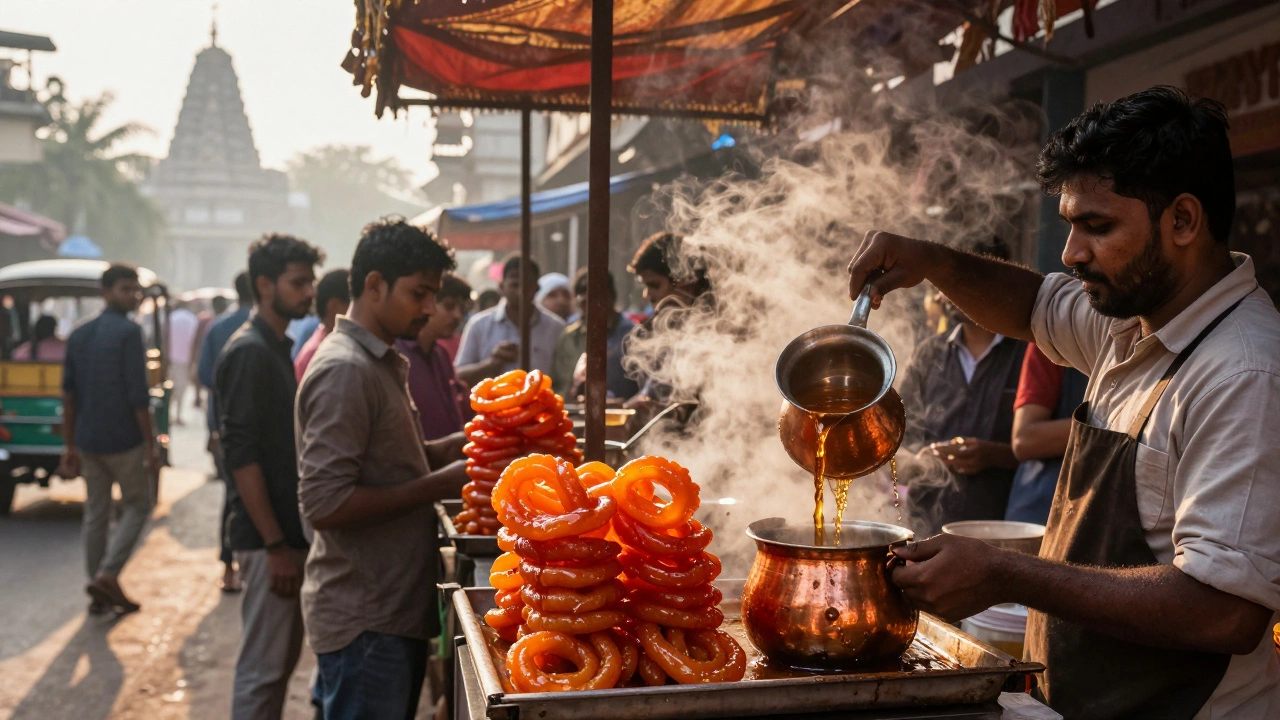
Jalebi isn’t just a sweet. It’s a cultural anchor. Deep-fried batter twisted into spirals, soaked in sugar syrup, and served hot - often with a dollop of thick, chilled rabri. It’s crispy on the outside, chewy inside, and sticky in the best way possible. You’ll find it in roadside stalls in Varanasi, fancy hotel buffets in Mumbai, and village fairs in Rajasthan. It’s the one dessert that doesn’t need a special occasion - it creates one.
But why jalebi over others? Let’s compare.
Jalebi vs. Gulab Jamun: The Classic Showdown
Gulab jamun is soft, melt-in-your-mouth, and soaked in rose-scented syrup. Made from khoya (reduced milk), it’s rich, creamy, and often served at weddings. It’s comforting. But it’s also heavy. One or two pieces are enough to satisfy.
Jalebi, on the other hand, is bright, tangy, and addictive. The syrup isn’t just sweet - it’s slightly fermented, giving it a subtle sour note that cuts through the sugar. The texture? Crunchy at first bite, then yielding to a warm, syrupy core. You don’t just eat jalebi - you savor it slowly, letting the syrup drip onto your fingers.
At Diwali, families make both. But if you walk into a sweet shop in Delhi during the festival, the jalebi line is twice as long. Why? Because jalebi is shared. It’s served in stacks, broken apart, passed around. Gulab jamun is often plated individually. Jalebi brings people together.
The Science Behind the Stickiness
What makes jalebi stick to your fingers and still taste amazing? It’s the syrup. Traditional jalebi syrup is made with sugar, water, and a pinch of lemon juice or saffron. The lemon juice prevents crystallization, keeping the syrup smooth. The saffron adds color and fragrance - not sweetness, just aroma.
The batter is fermented overnight. That’s the secret. Fermentation creates tiny air pockets, so when the batter hits hot oil, it puffs up into those perfect spirals. If you skip fermentation, the jalebi turns out flat and greasy. No one wants that.
Real jalebi is made fresh, every day. You can’t freeze it. You can’t reheat it without losing the crunch. That’s why street vendors start frying at 5 a.m. and sell out by noon. It’s not a dessert you make ahead of time - it’s a dessert you experience in the moment.
Regional Variations You Won’t Find in a Cookbook
In Gujarat, they make jalebi with maida (refined flour) and serve it with a side of chilled buttermilk to balance the sweetness. In Bengal, they call it jilapi and sometimes add cardamom to the syrup. In Uttar Pradesh, the spirals are bigger, the syrup thicker, and they serve it with rabri - a slow-cooked milk reduction that’s like Indian ice cream.
Then there’s the south. In Tamil Nadu, they make a version called jalebi but use rice flour instead of wheat. It’s lighter, less chewy, and often paired with coconut chutney. In Andhra, they fry it in ghee instead of oil for a richer flavor.
These aren’t just variations. They’re regional identities. Each version tells a story about local ingredients, climate, and tradition.

Why Jalebi Beats Rasgulla and Kheer
Rasgulla is soft, spongy, and made from chhena (cottage cheese). It’s popular in West Bengal and Odisha. But it’s delicate. It doesn’t travel well. It needs refrigeration. You can’t eat it on a hot street corner without it falling apart.
Kheer is rice pudding. Creamy, mild, and often served at religious ceremonies. But it’s bland compared to jalebi. It doesn’t spark joy - it soothes. Jalebi does both.
And then there’s the visual factor. Jalebi is orange-red, glowing in the sunlight. It looks like a piece of candy art. Rasgulla is white. Kheer is beige. Gulab jamun is brown. Jalebi stands out. It’s Instagram-ready before Instagram existed.
It’s Not About Taste - It’s About Emotion
Indian desserts aren’t just sugar. They’re memory. Jalebi is the first sweet a child eats at a temple fair. It’s what your grandmother served when you came home from school. It’s the treat you get after acing a test. It’s the one thing your uncle brings when he visits from another city.
It’s not the most expensive. It’s not the most exotic. But it’s the most present. You’ll find jalebi at a newborn’s naming ceremony. At a funeral feast. At a cricket match. At a political rally. It’s the dessert that says, “We’re celebrating, even if we don’t know why.”
That’s why, despite hundreds of Indian sweets - from barfi to peda to laddoo - jalebi remains the most loved. It’s not about perfection. It’s about presence.

How to Spot Real Jalebi
Not all jalebi is created equal. Here’s how to tell the good from the fake:
- Color: Real jalebi is deep orange or red, thanks to food coloring or saffron. Pale yellow means it’s fresh but not traditional.
- Texture: It should be crisp on the outside, with a soft, syrupy center. If it’s soggy, it’s been sitting too long.
- Syrup: It shouldn’t be cloying. There should be a hint of tang - that’s the fermentation. If it’s just sugar, it’s not authentic.
- Heat: Real jalebi is served hot. Cold jalebi is just sticky sugar. You can’t fake the warmth.
- Line: If there’s a line outside the shop, trust it. No one waits 20 minutes for bad jalebi.
Can You Make It at Home?
Yes - but don’t expect perfection on the first try. You need:
- 2 cups all-purpose flour
- 1/4 cup yogurt (for fermentation)
- 1/2 tsp baking soda
- 2 cups sugar
- 1 cup water
- Pinch of saffron or food coloring
- Oil for frying
Let the batter ferment overnight. Heat oil to medium. Use a squeeze bottle or piping bag to swirl the batter into circles. Fry until golden. Drop into hot syrup for 30 seconds. Serve immediately.
It’s messy. It’s time-consuming. And it’s worth every sticky finger.
What About Modern Twists?
Some chefs now make jalebi with almond flour, coconut sugar, or even vegan yogurt. Some serve it with matcha syrup or chocolate drizzle. These are fun - but they’re not the jalebi that’s been passed down for centuries.
Traditional jalebi doesn’t need innovation. It just needs to be made with care, fresh, and shared.
So, what’s India’s best dessert? It’s not the one with the most sugar. It’s the one that brings people back - again and again - to the same spot, the same flavor, the same joy.
That’s jalebi.
Is jalebi the most popular Indian dessert nationwide?
Yes, jalebi is the most widely recognized and consumed Indian dessert across all regions. While states have their own favorites - like rasgulla in Bengal or peda in Mathura - jalebi appears at festivals, weddings, temples, and street stalls from Kashmir to Kanyakumari. It’s the only Indian sweet that transcends regional boundaries in both popularity and cultural significance.
Can I store jalebi for more than a day?
No, jalebi doesn’t store well. After 6-8 hours, it loses its crispness and becomes soggy. Refrigerating it makes it even worse - the syrup turns watery and the texture turns rubbery. Real jalebi is meant to be eaten fresh, ideally within an hour of being made. That’s why street vendors make it in small batches throughout the day.
Is jalebi gluten-free?
Traditional jalebi is not gluten-free because it’s made with maida (refined wheat flour). However, some modern versions use rice flour, chickpea flour, or almond flour to make gluten-free alternatives. These are not common in India but can be found in specialty bakeries abroad. The authentic version always contains wheat.
Why is jalebi often served with rabri?
Rabri is a thick, slow-cooked milk dessert sweetened with sugar and flavored with cardamom and saffron. Serving jalebi with rabri balances textures and temperatures: hot and crispy meets cold and creamy. It also cuts the sweetness. The richness of the milk softens the sharp sugar of the jalebi, making it more complex and satisfying. It’s a classic pairing in North India, especially in Uttar Pradesh and Delhi.
Do Indians eat jalebi for breakfast?
Yes, especially in North India. In cities like Lucknow, Varanasi, and Jaipur, it’s common to see people buying jalebi with a cup of chai for breakfast. It’s not a health food - but it’s a cultural one. The warmth and sweetness give a quick energy boost, and the ritual of eating it hot from the vendor is part of the morning routine for millions.
What’s the difference between jalebi and funnel cake?
Funnel cake is made from batter fried and dusted with powdered sugar. Jalebi is fermented, shaped into spirals, and soaked in flavored syrup. The fermentation gives jalebi a slight tang and chewier texture. Funnel cake is sweet and airy; jalebi is sweet, tangy, and dense. They look similar, but the flavor, technique, and cultural role are completely different.
Is jalebi vegan?
Traditional jalebi is not vegan. The batter often includes yogurt, and it’s sometimes fried in ghee. However, you can easily make a vegan version by replacing yogurt with plant-based yogurt or buttermilk and using vegetable oil instead of ghee. The syrup is already vegan (just sugar and water). Many street vendors in urban areas now offer vegan options upon request.
Why is jalebi orange or red in color?
The bright color comes from either food coloring (usually red or orange) or natural saffron. Saffron is expensive, so most vendors use food-grade coloring to get the signature look. The color isn’t just for show - it signals freshness and tradition. A pale yellow jalebi might taste fine, but it won’t feel like the real thing. The vibrant hue is part of its identity.